.webp)

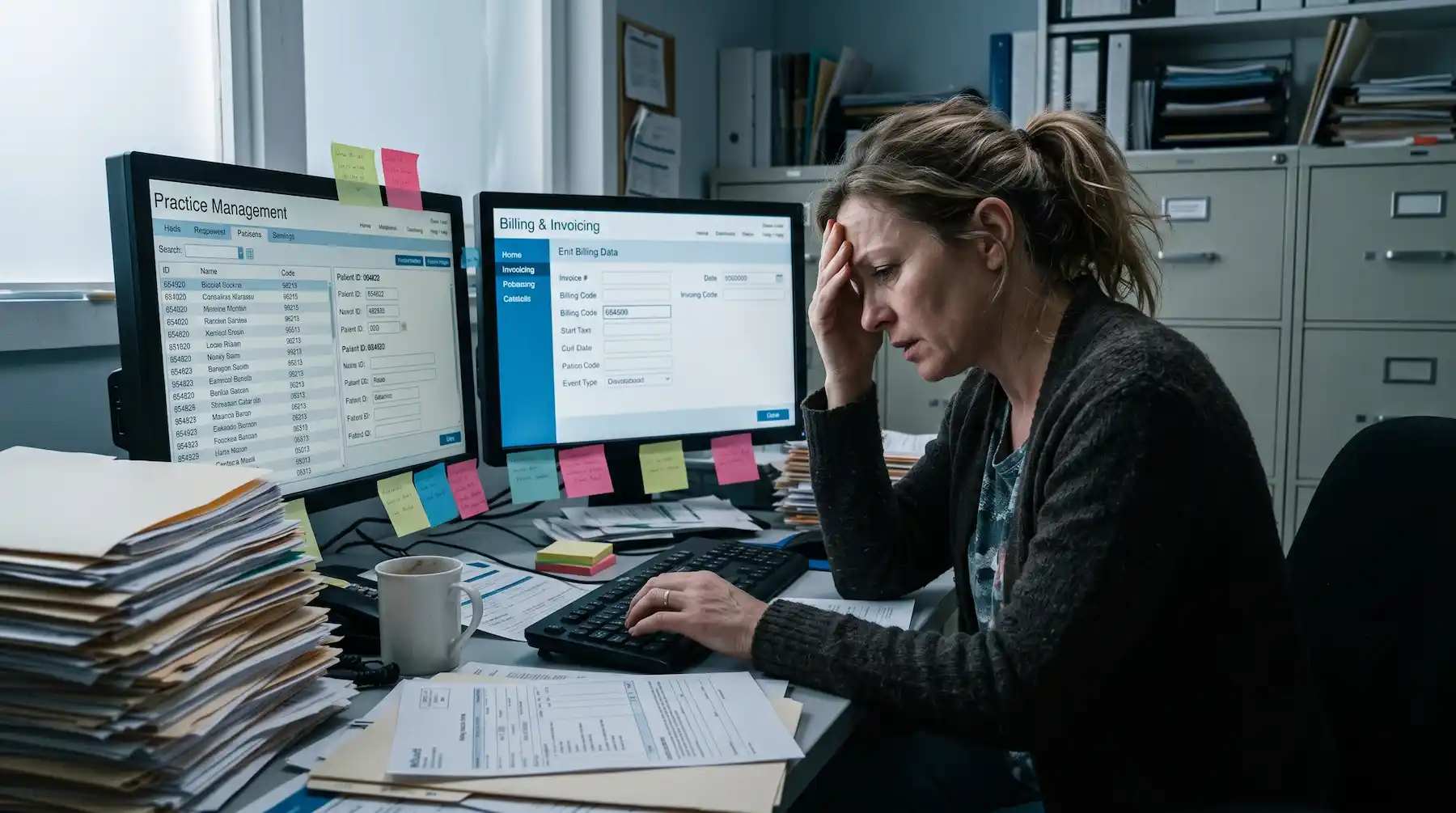
Monday morning. Coffee in hand. Revenue report open. You scroll to the aging claims list and see the same line item that’s been there for three weeks: Pending.
No denial. No payment. No update.
Just pending.
You tell yourself it’s normal. Payers take time. Authorizations run long. Clearinghouses lag. You move on to the next task.
But somewhere underneath that routine is a quiet anxiety most ABA leaders recognize and rarely name:
If nothing is happening, how would we even know?
Here’s the uncomfortable insight: A claim without a status isn’t “waiting.” It’s invisible to the team trying to manage it.
And invisibility—not delay—is where revenue risk begins.
What “Pending” Actually Means in ABA Billing
In most ABA billing workflows, “pending” functions as a holding label. It tells you the claim hasn’t been paid and hasn’t been formally denied. That’s it.
It does not tell you whether the payer received it. Whether it passed initial edits. Whether it's in active review or has been quietly stalled at the clearinghouse since week one.
The claims lifecycle (submission, acceptance, adjudication, payment or denial) generates a signal at each step when things are working (e.g., acceptance reports, acknowledgment files, status updates). When those signals are not visible for the practice, "pending" just means unknown.
Some pending claims are legitimately under review. Others:
- Failed initial clearinghouse edits and were never corrected
- Were rejected, but the rejection wasn't surfaced clearly
- Contain minor data mismatches that stalled adjudication quietly
- Were never properly transmitted to the payer at all
The four scenarios above require four different responses. But inside most billing workflows, they all look the same.
The Difference Between a Slow Payer and a Claim That Was Never Received
Most ABA operations leads know what a slow payer looks like. You learn their patterns, adjust your cash flow expectations, and escalate when they breach contractual timelines. Slow payers are frustrating, but they're manageable, because they leave evidence: An electronic acknowledgment. A portal status. A traceable adjudication history.
A claim that was never properly received leaves none of that. No trail. No signal. Just the same "pending" label on the same line in the aging report, sitting next to claims that are genuinely in adjudication and moving fine.
That ambiguity creates a fork in the road for billing teams, and neither path is good:
- Chasing everything → Staff call on every aging claim, payer reps get overwhelmed, internal hours disappear, and you still don't have prioritization logic.
- Chasing nothing → Teams assume slow payers are the explanation, allow more time, and only intervene once the claim has aged into denial territory or past the filing deadline.
The difference between those two scenarios —slow payer vs. claim never received— determines your entire intervention strategy. One requires contractual follow-up. The other requires immediate resubmission or correction. When you can't tell them apart, you're not managing revenue. You're managing uncertainty.
📌 Also read: Ending the Claim Denial Cycle That’s Costing ABA Practices Thousands of Dollars
How Billing Ambiguity Spreads Across ABA Practices
The risk of unclear claim status rarely announces itself. It accumulates quietly, in places that don't always look like billing problems.
At the team level, administrative staff spend hours navigating payer portals and reconciling clearinghouse reports without knowing where to start. Every claim feels equally urgent because none have clear signals attached. Instead of asking "which claims need action today?" the question becomes "which ones should we check again?". And that's a harder, slower, less satisfying question to work from.
Prioritization becomes guesswork. Follow-up becomes habit rather than strategy. Resubmission windows get missed. Outreach goes undocumented.
At the leadership level, the effect shows up differently. Financial ambiguity shapes operational decisions in ways that are hard to trace back to billing:
- Hiring decisions that keep getting pushed
- Overtime restrictions that affect clinical capacity
- Hesitation around adding a new payer or opening a second location
Nobody says "we're not hiring because we don't trust our claim status." But when revenue can't be confidently forecasted, the organization tightens, and the downstream cost of that tightening is real, even when it's invisible.
What Changes for ABA Teams When Claim Status Is Clear
When claim status is clearly differentiated and actively monitored, the work changes character.
Instead of treating all pending claims as equivalent, teams can confirm which claims are in adjudication and moving, identify which lack payer acknowledgment entirely, and prioritize follow-up based on actual risk, not just days outstanding.
Follow-ups become intentional. Outreach decreases because it's guided by real claim movement rather than assumption. And small issues like a data mismatch or a missed edit get caught before they become denials rather than after.
This isn't a technology problem or a staffing problem. It's a visibility problem. The good news? That's the fixable kind.
Catch Your Billing Issues Before They Turn Into Denials
By the time a claim comes back denied, you've already missed the window to prevent the problem. The real risk starts earlier, when claims sit without confirmation that they're moving at all.
That's where Motivity's RCM team can step in. Rather than waiting for denials to surface and working backwards, we monitor claim progression at each stage of the lifecycle, distinguishing payer delay from submission failure, flagging issues before intervention windows close, and handling the follow-up so your internal team isn't spending their time guessing.
You don't need to build a perfect billing operation from scratch. You need a team that knows where to look and what to do when they find it.
If your aging report has claims that haven't moved in weeks, that's worth a conversation.