
Learning a new skill can be challenging for anyone. For individuals with developmental disabilities, including autism, that process often requires more repetition, structure, and support. But with the right guidance from a Board Certified Behavior Analyst® (BCBA®), learners can build meaningful skills that support greater independence over time.
Across many types of therapy, one instructional tool shows up again and again: prompts.
Prompts are used during instruction to guide learners toward the correct response in a given situation. Whether the goal is communication, daily living skills, or classroom behavior, prompts act as temporary supports that help bridge the gap between not knowing a skill and performing it independently.
What Is a Prompt in ABA?
In Applied Behavior Analysis (ABA), a prompt is a cue given before or during a learner’s response to help guide them toward the correct behavior. Prompts can take many forms, from physical guidance to verbal cues or visual supports.
The purpose of prompting is to support learning. Over time, prompts must be reduced so the learner can respond correctly without external assistance.
For example, when teaching a learner to put on their shoes, an RBT® might initially point to the shoes, model the action, or provide brief physical guidance until the learner can complete the task independently.
What Does Prompt Fading Mean?
Prompt fading refers to the gradual reduction of prompts over time so learners do not become dependent on them. The long-term goal of ABA therapy is independence, meaning the learner responds appropriately to a stimulus without cues, hints, or guidance.
If prompts remain in place too long or are reduced inconsistently, learners may appear successful while still relying heavily on support. Planned prompt fading helps prevent that pattern by making independence the expectation, not the exception.
Difference between Stimulus and Prompts
A stimulus is a natural signal that should evoke a response on its own. For example, rain is the stimulus that may lead someone to grab an umbrella, or darkness is the stimulus that may lead someone to turn on a light.
Prompts are different. They are added supports, used only during learning.
For instance, telling a learner to “say hello” when someone enters the room is a prompt. The presence of a new person is the stimulus. The goal is for the learner to respond to the stimulus without needing the vocal reminder.
Types of Prompts Used in ABA
ABA uses several types of prompts, ranging from more intrusive to less intrusive. The prompt selected depends on factors such as the learner’s current skill level, learning history, and how much support is needed for success.
Below are common prompt types used in ABA.
Prompt Hierarchy: The Pyramid of Help
All prompt types exist on a continuum from most intrusive to least intrusive. A prompt hierarchy in ABA organizes these prompts to guide how support is provided and gradually reduced.
Typically, instruction begins with more intrusive prompts and moves toward less intrusive prompts as the learner gains independence, although sometimes it is presented the other way around.
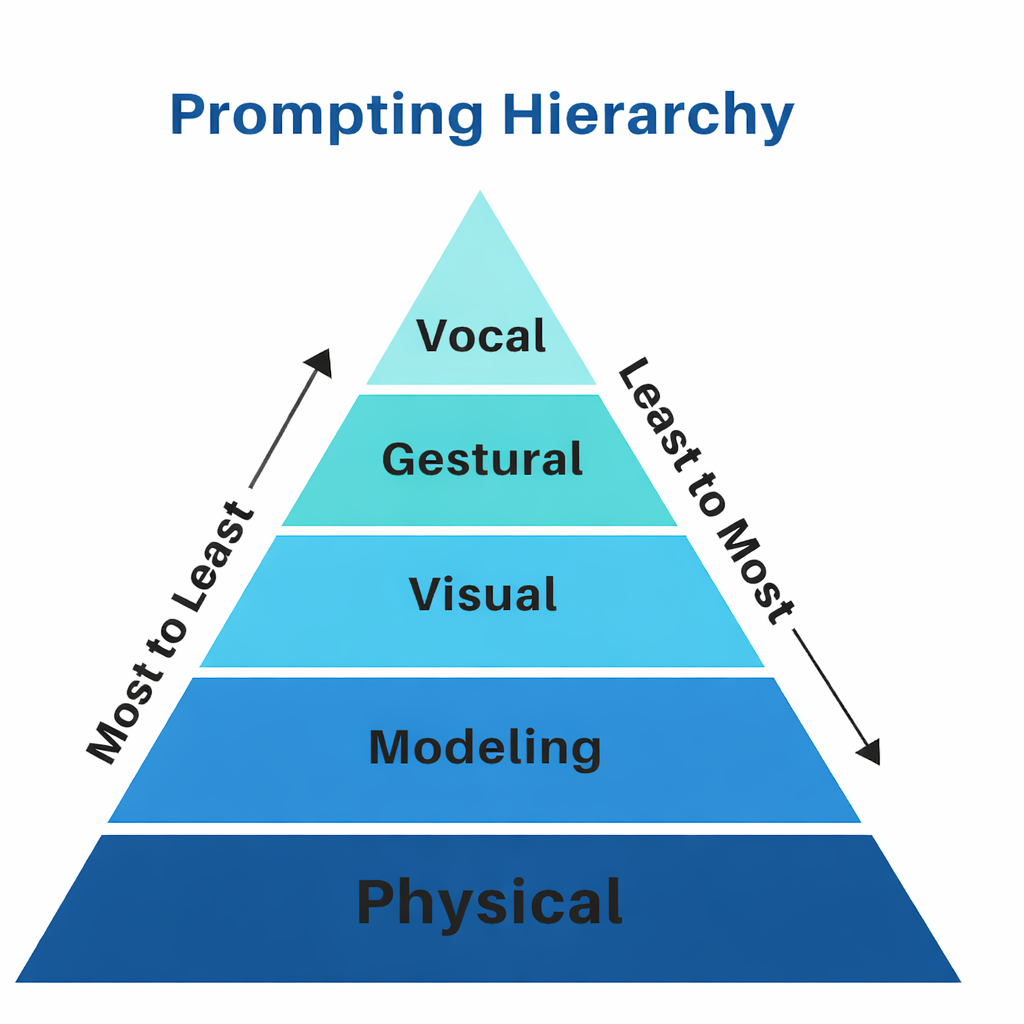
There are two common ways to apply a prompt hierarchy in ABA.
1. Most-to-least Prompting
Most-to-least prompting begins with the highest level of support to ensure the learner contacts the correct response. As the learner becomes more successful, prompts are reduced over time.
This approach is often used when teaching multi-step tasks, such as preparing a snack or completing a morning routine, where early errors could be discouraging or confusing.
2. Least-to-most Prompting
Least-to-most prompting starts with minimal support and increases only if the learner does not respond correctly.
For example, teaching an autistic child to sit down might follow this sequence:
- Visual: Placing a chair next to the person
- Indirect vocal: Asking “Do you want to sit down?”
- Direct vocal: Saying “Please sit down”.
- Gestural: Pointing to the chair.
- Modeling: The instructor sits on the chair first to signal the child to also sit down.
- Partial physical: Propelling the child towards the chair.
- Full physical: Physically making the child sit down on the chair.
In a busy session, this often means pausing briefly after each level to allow the learner a chance to respond before increasing support.
The choice between approaches depends on the learner, the skill, and the instructional context. ABA teams often adjust prompting strategies based on real-time learner performance.
Time Delay Prompting in ABA
Time delay prompting involves increasing the pause between an instruction and a prompt. This gives the learner an opportunity to respond independently before help is provided.
Example of Time Delay Prompting
Teaching a child to identify a color (e.g., "red") using Constant Time Delay:
- Immediate Prompt Phase:
- Instruction: "What color is this?"
- Prompt: Immediately say "Red."
- Response: The child repeats "Red."
- Reinforcement: Provide praise or a reward for the correct response.
- Introduce Time Delay:
- Instruction: "What color is this?"
- Delay: Wait for 5 seconds.
- Prompt (if needed): Say "Red" if the child does not respond within 5 seconds.
- Response: The child says "Red."
- Reinforcement: Provide praise or a reward for the correct response.
- Increasing Independence:
- Gradually, the child begins to respond correctly before the prompt is given.
- Continue to reinforce correct independent responses and maintain the 5-second delay until prompts are no longer needed.
- Independent responses can and should receive a more valuable reinforcer.
Why Prompt-Level Visibility Matters in Practice
An RBT may run dozens of trials across multiple targets in a single session, making rapid decisions about how much support to provide on each opportunity. On paper data sheets, this often means shorthand, such as circling “PP” for partial physical prompts or “G” for gestural prompts, while trying to keep instruction moving.
Small inconsistencies in how those prompt levels are recorded can add up, especially once the session ends and the data needs to be reviewed. These gaps rarely reflect poor planning. They reflect the reality of time pressure and human limits.
When prompt-level data is fragmented or reconstructed later, it becomes harder for a BCBA® to clearly see fading patterns or recognize when a learner is ready for increased independence.
Some ABA teams address this by capturing prompt levels during the session itself, so fading progress is visible immediately rather than inferred afterward. Tools like Motivity support this approach by recording prompt-level data in real time and reflecting it directly in session graphs, allowing supervisors to review prompt use in context.
That visibility can change how quickly teams respond. At Northwest Behavioral Associates (NBA), clinicians had a 340% increase in intervention agility after moving away from traditional paper-based programs.
For teams moving beyond paper-based systems, having prompt-level data available in real time can shift prompt fading from a retrospective exercise to an active part of instruction. Motivity is designed to support this shift by making prompt use visible as sessions unfold, helping teams apply well-designed prompt hierarchies more consistently in practice. If exploring how that looks in a real workflow would be helpful, you can schedule a time with us and we’ll show you live.