
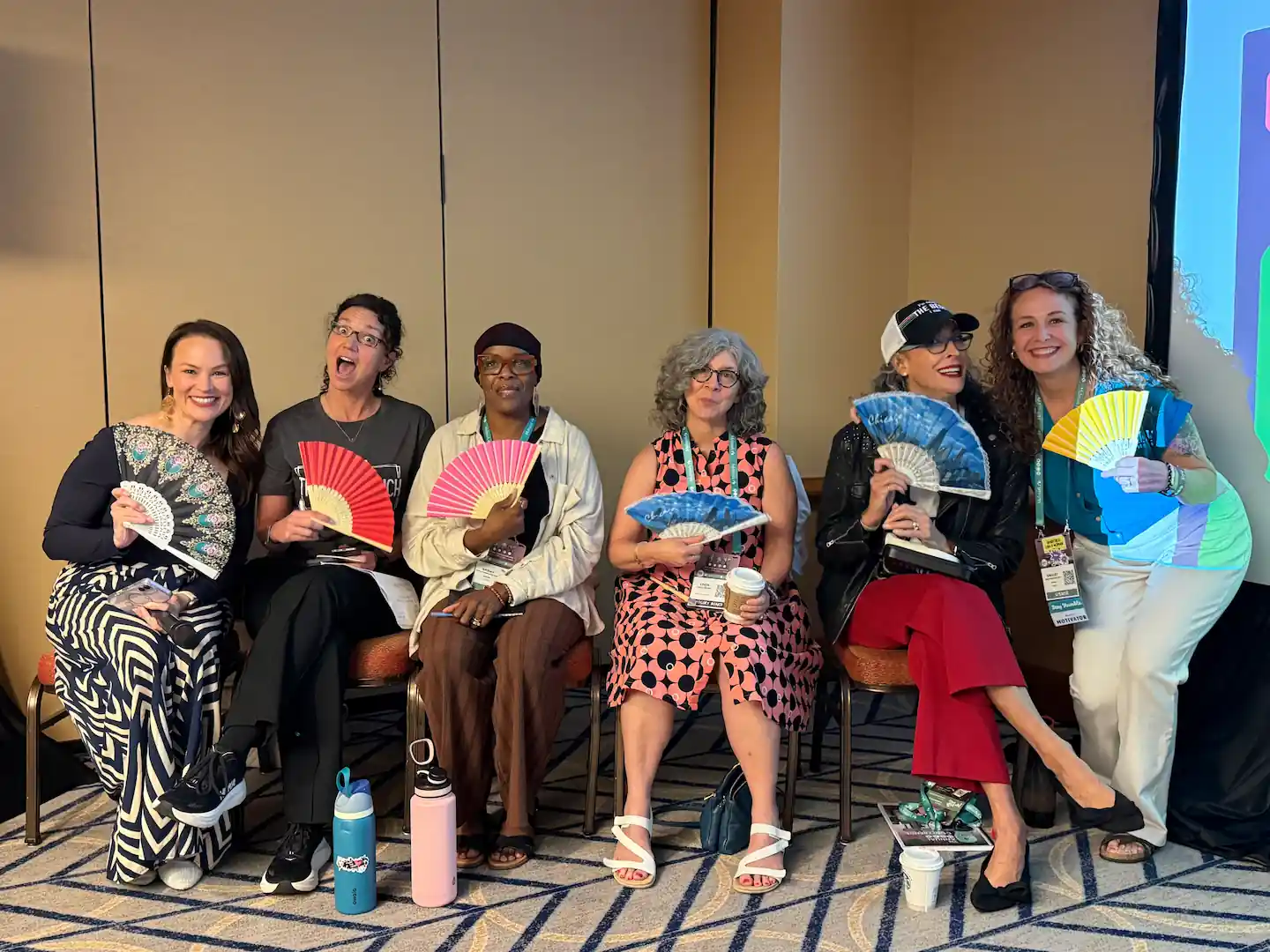
During last month’s Women in Behavior Analysis (WIBA) Conference, I had the privilege of chairing a panel I had long hoped to see — though I honestly wasn't certain if our field was prepared for it.
The title was Hot Flashes and High Stakes: Navigating Perimenopause and Menopause as Behavior Analysts. The room was full. And what happened over the next hour reminded me of why these conversations matter so much.
The gap we don't talk about
Women make up the majority of the behavior-analytic workforce. We are clinicians, supervisors, researchers, and executives. We run sessions, lead organizations, train the next generation of practitioners, and make high-stakes decisions every day.
And yet perimenopause and menopause — biological transitions that can profoundly affect how we think, feel, remember, perform, and lead — have been almost entirely absent from our professional discourse.
Prior to opening the discussion, I posed a straightforward poll question to the audience: has perimenopause or menopause had an impact on your career as a behavior analyst? The immediate and definitive responses made it clear that the room was carrying the collective weight of this life stage, and we were finally opening the door to this essential conversation.
Looking at it through our own lens
I opened by offering a reframe that I think changes everything about how we approach this topic: perimenopause and menopause are not character flaws, burnout, anxiety disorders, or weakness. They are establishing operations — powerful, prolonged biological conditions that alter what is reinforcing, what is aversive, and what requires effort, without being behaviors themselves.
As behavior analysts, we apply this lens to our clients every day. The invitation today was to apply it to ourselves.
And here is what makes that lens particularly interesting: establishing operations can open up new conditions that may become newly reinforcing. Traditional Chinese Medicine calls this Second Spring — the idea that menopause is not a decline but a redistribution of energy and wisdom. Through a behavioral lens, that tracks. If much of our earlier behavior was maintained by external social contingencies — approval, performance, fitting a role — then this transition can function as a kind of extinction of those contingencies, clearing the way for behavior more directly connected to our own values. What looks like loss from the outside may be a thinning schedule leading to something more durable. More self-directed. More authentic.
That framing set the tone for everything that followed.
What our panelists brought to the room
I was joined by five extraordinary behavior analysts, Janet Lund, Lexi Rand, Linda LaBlanc, Ansley Hodges, and Nasiah Cirincione-Ulezi. Together we brought something rare: the combination of deep clinical expertise and radical personal honesty.
Lexi Rand opened a conversation that stopped the room. She described experiencing a speech block during a professional meeting — words simply not coming — and reframed it through the concept of a behavioral cusp. Perimenopause, she argued, is one of the most significant cusps a behavior analyst will experience: a point at which the variables controlling our behavior shift fundamentally, and our existing repertoire is no longer sufficient. That reframe from "something is wrong with me" to "my behavioral landscape has changed and I need new tools", is exactly the kind of perspective shift our field can uniquely offer.
Linda LaBlanc spoke about rules — specifically, the rules many of us have been following our entire careers that stop tracking reality during this transition. The rules about how much we can take on, how we should present, what we owe to others' comfort. Menopause, she offered, is an invitation to replace those rules with ones that actually serve us now.
Ansley Hodges shared her experience navigating medical issues and the emotional complexity that came with it — and named something many in the room had never heard said out loud in a professional context: that this transition requires community, not just clinical strategies. That we cannot behavior-analyze our way through it alone.
Nasiah Cirincione-Ulezi brought a perspective the conversation needed. For Black women, the journey to finding medical providers who listen is not simply inconvenient — it is shaped by a history of mistrust between the Black community and the medical system that is real, documented, and ongoing. Advocacy, she reminded us, looks different depending on who you are and what room you're walking into. That truth belongs in this conversation.
Janet Lund talked about data — specifically, how using an Oura Ring to track heart rate variability, body temperature, and sleep patterns gave her objective information that she could use to advocate for herself, adjust her schedule, and stop second-guessing what her body was telling her.
The strategies that actually work
When I asked panelists to share their most effective behavioral strategies, the answers were specific and immediately actionable.
Lexi described counting backwards from 300 by threes when she woke at 2am with a racing mind — an evidence-based technique for interrupting rumination that she had adapted for herself. Janet talked about treating her Oura data the way she would treat client data: using it to identify patterns, make decisions, and build a case with her medical provider. I shared my own practice of scheduling low-demand morning meetings with trusted colleagues first — using behavioral momentum to build into more demanding work rather than starting the day fighting against a nervous system that needs a runway.
What emerged across all of these was a consistent theme: the same technology we use for our clients — assessment, antecedent modification, self-monitoring, behavior momentum — works applied to our own environment and behaviors.
What I'm taking away
I've been in this field for a long time. I've sat on a lot of panels. This one felt different because the people in that room were not just learning something new. They were being seen, many of them for the first time in a professional context, in the fullness of what they are carrying.
Perimenopause and menopause will touch the majority of our workforce. They already are. And our field has something genuinely valuable to offer — a framework for understanding behavioral change without pathologizing it, tools for self-management grounded in evidence, and a professional culture that, if we choose, can model the psychological safety it takes to talk about hard things.
That work starts with conversations like the one we had last week. I'm grateful to WIBA for creating the space, to my panelists for their courage and honesty, and to everyone in that room who showed up — for themselves and for each other.
The conversation is just beginning. I hope you'll join it.
To support this work, the panelists and I have put together a resource guide for those navigating perimenopause and menopause, providing a list of symptoms, research, data tools, and services to look into while navigating care.
Emaley McCulloch is Chief Clinical Officer at Motivity, a behavior analyst, and a passionate advocate for evidence-based approaches to clinical leadership, workforce wellbeing, and women's health in the ABA field.