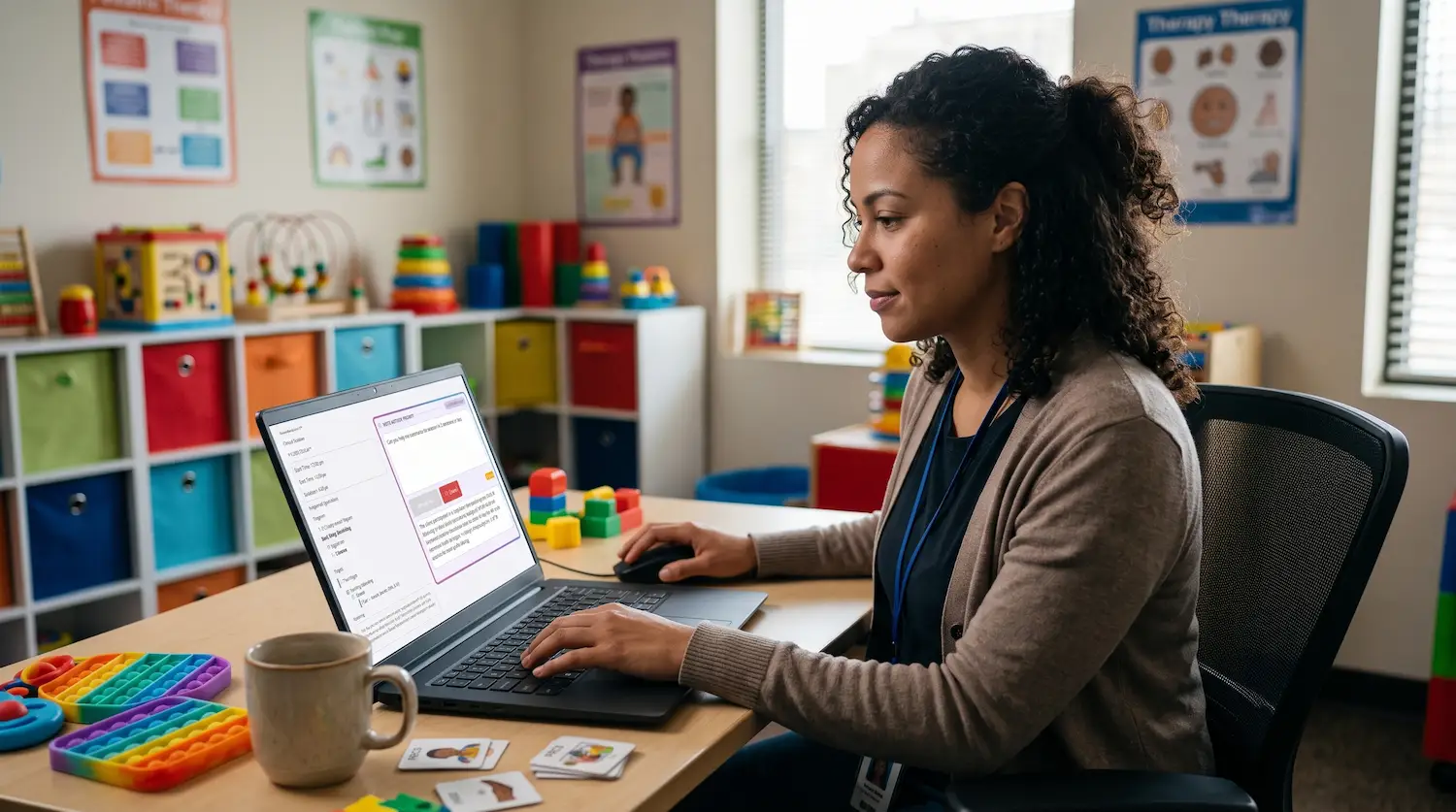
When ABA leaders ask me about AI session notes, the questions tend to be similar: Will payors accept this? What if my staff stops reading what they sign? Who's responsible when the draft is wrong?
I hear these from people who are accountable for documentation quality across dozens or hundreds of clinicians. And as a BCBA® on Motivity's AI taskforce, here's what I tell them.
What a payor or auditor will see when they open the session note
A session note that was drafted with AI assistance should look like any other clinical record when it reaches a payor or auditor. That means a signed narrative, the session data behind it, and documentation that meets your funder's requirements. No AI interface, no prompt fields, no internal drafting tools visible in the final record. If the tool you're using exports anything that exposes the AI workflow in the clinical document, that's a red flag.
Whether that record holds up depends on the same things it always has. The narrative needs to match the session data. It needs to meet your funder's documentation requirements and must have been reviewed by the person who signed it.
AI changed how the first draft gets written. It didn't change what makes a note defensible.
Here's what I tell leaders who are working through this: go back to your funder requirements by session type. CASP’s practice parameters for AI in ABA are direct on this point: most healthcare funding sources don't yet address AI in their ABA policies, and organizations shouldn't assume payors will permit or reimburse every use of AI by practitioners. Where a funder's policy doesn't specify, CASP recommends providing them a transparent description of how you intend to use it. That's a conversation worth having before rollout.
In Motivity, you can enable AI on some session note templates and not others, on some text boxes and not others, and for some roles and not others. That kind of granularity matters because a 97153 direct treatment note and a 97155 protocol modification don't carry the same documentation requirements, and your decision about AI doesn't have to be the same for both.
Accountability doesn’t change, even when the draft does
Regardless of what helped produce it, the person who signs a session note is responsible for the accuracy of everything in it. AI should serve as a tool to support clinical work, not replace it.
Another question I hear is whether AI will de-skill clinicians by doing the writing for them. I don't see it that way. Writing a clinically accurate session note requires more than putting sentences together. It takes training, clinical judgment, and critical thinking to interpret session data, identify what's relevant, and accurately describe what happened. AI can help turn that information into a first draft, but it doesn't replace the skills needed to recognize whether that draft is accurate, complete, and clinically meaningful.
In practice, that means the signer should be reading the narrative with the same attention they'd give a note a peer handed them for review. Can they verify every statement against the session data? Does the narrative reflect what actually happened? Is there anything in there that the signer didn't observe or that the data don't support? What needs to be edited, added, or removed?
For Motivity’s AI session note narrative generator, the author has to check a statement confirming they've personally read, verified, and approved the clinical accuracy of the narrative before signing. They can edit every word before that point. Once they sign, the note carries their name. Of course, there's no way to record how closely they read, so the accountability has to live in your practice.
Also read: Designing AI Session Notes for the ABA Teams Who Write Them
Treat it like any draft, and check it against the data
When you're evaluating any AI session note tool, one of the first questions to ask is what information the AI can access. Does it read only the current session note, or can it pull from historical sessions, learner profiles, or other records?
Inside Motivity, the AI writes only from what's on the note in front of it: the session data, the form fields, and whatever the author typed in. It can't access the learner's history, previous session notes, or anything outside that single note. We chose that constraint because a system that reaches into historical data could write something that sounds right but didn't happen in that particular session.
Even with that boundary, the draft should be treated like what it is: a draft. AI can take the information provided and turn it into a narrative, but that doesn't mean every word or phrase will perfectly capture what happened during the session. Read it alongside the session data, and don't hesitate to make edits. The goal isn't just a well-written note; it's an accurate representation of the session.
Your session data stays out of model training
One of the most common concerns I hear is about data privacy. Specifically, what happens to the clinical information your team enters when the AI generates a draft?
What I can tell you specifically about session notes in Motivity: session data are not used to train the underlying AI models, and they don't leave the infrastructure to feed any external system.
The AI has been configured to understand ABA terminology and clinical language, but it doesn't learn your organization's specific preferences from use. If you want notes structured a certain way, or if you use particular terms for session types, you tell it through your prompt instructions. Those are editable at the template level, and you can adjust them any time. You can also refer to our Suggested Prompt Bank to get started.
Related read: What HIPAA Compliance Looks Like When AI Enters Your ABA Practice
Turning it on before you define a good note costs you later
If I could give just one piece of advice before enabling AI for session notes, it would be: define what a good note looks like, by session type, with specific terminology, structure, and the elements you always want to see.
If your standard is clear and encoded in your templates and prompt instructions, the drafts will come out closer to what you'd want to sign. If it's vague, or if it lives only in individual supervisors' heads, the output will be inconsistent.
We ran a study with different ABA provider organizations before launching Motivity’s AI session notes narrative generator, and one finding that stood out to me was how much implementation explained the variation in results. Across those organizations, the amount of AI-generated text that authors changed ranged from about 2.5% to 24%, and that gap tracked directly with how much work each organization had put into their documentation standard and prompt configuration before they started. The full research findings are available if you want to go deeper, along with a phase-by-phase rollout framework based on these findings.
We built this to keep clinicians in control
At Motivity, the question we started with wasn't “Can we add AI to session notes?” It was “How do we make documentation easier without pulling clinical decisions away from the person who was in the session?”
That question set the boundaries for what we built. The AI drafts the writing. The clinician reads it, edits it, and puts their name on it. They decide whether what's on the screen matches what happened in the room.
These are the questions I get asked most. If yours isn't here, our team is always available to talk.