
Reinforcement schedules can feel like something you learned once for an exam and now fill in on autopilot. But the choice behind FR 3 or VI 2 minutes is a real clinical decision that changes as a skill moves from brand-new to fluent or maintained. This guide unpacks that decision the way it happens, using one learner's program to walk through it.
Editorial note: Ari and Jordan are fictional composite characters used to illustrate clinical decision-making. Examples are educational and are not substitutes for individualized assessment, supervision, or treatment planning.
Ari does not have one reinforcement schedule. The 6-year-old learner is acquiring a new way to ask for help, becoming more fluent with familiar matching tasks, participating in small-group activities, learning a handwashing routine, and practicing how to request a break when work becomes difficult. Each response serves a different purpose. Each is at a different stage of learning. Each may require a different reinforcement arrangement.
That is where Jordan, Ari's BCBA, begins. Instead of asking, "Which schedule is best?" Jordan asks a more useful set of questions: What response are we teaching? What consequence is functionally relevant? How established is the skill? What pattern of responding does the learner need? What can caregivers and staff implement consistently? What should reinforcement look like in the natural environment?
Those questions turn reinforcement schedules from exam vocabulary into clinical tools. This guide follows Jordan and Ari through those decisions, beginning with continuous reinforcement and the four basic intermittent schedules, then moving into schedule thinning, multiple schedules, chained schedules, and other concepts that matter when basic categories are no longer enough.
What a reinforcement schedule actually specifies
A schedule of reinforcement is the rule that specifies which instances of a response will produce reinforcement. Reinforcement is not defined by what the clinician intends to be rewarding. A consequence functions as reinforcement only when it increases or maintains the future probability of the behavior it follows.
Schedules can influence how quickly a response is acquired, how responding is paced over time, how persistent it is when reinforcement becomes less frequent, and whether a treatment can be implemented outside a highly controlled setting. But a schedule does not operate in isolation. Response effort, reinforcer quality and immediacy, motivating operations, prompting, competing sources of reinforcement, and treatment integrity can all change what clinicians observe.
A useful memory aid: Ratio schedules count responses. Interval schedules determine when reinforcement becomes available, but a qualifying response must still occur.
Teaching a new help request with continuous reinforcement
During a construction activity, Ari sometimes pushes materials away when a piece will not fit. Jordan and the team decide to teach a help request that Ari can emit vocally or with an AAC device. At the beginning of instruction, every independent help request immediately produces help. This is continuous reinforcement, also described as a fixed-ratio 1 schedule.
The consequence matches the communication response: Ari asks for help and receives help. Praise may accompany the interaction, but praise is not substituted for the requested outcome. The team records prompted and independent communication separately so a rising number of prompted responses is not mistaken for independent acquisition.
Dense reinforcement makes the response-consequence relation easy to contact while a skill is new. That does not mean CRF must continue indefinitely. It means Jordan waits for evidence that the response is established before making reinforcement less frequent, less immediate, or otherwise more like the natural environment.
Schedule Snapshot: Continuous Reinforcement and FR 1
Building fluency with ratio schedules
Ari can already match familiar objects accurately. For this program, the question is no longer whether Ari can perform the response at all. Jordan wants to build fluent, sustained independent responding without delivering the programmed reinforcer after every match.
The team first moves from FR 1 to FR 2: two qualifying independent responses are required before reinforcement. If accuracy remains stable and pauses do not become clinically disruptive, the requirement may increase gradually. Under fixed-ratio schedules, relatively high response rates are common, along with a postreinforcement pause. The pause often becomes longer as the ratio requirement grows.
Schedule Snapshot: Fixed Ratio
Later, Jordan considers a VR 3 schedule. The requirement changes from one delivery to the next but averages three responses. A programmed sequence might be 2, 4, 3, 2, and 4. Variable does not mean that the technician reinforces whenever it feels convenient. The sequence should be planned well enough for the obtained schedule to approximate the intended schedule.
Schedule Snapshot: Variable Ratio
Using interval schedules without confusing time and responding
Ari also participates in a small-group activity. The team wants appropriate participation to occur throughout the group rather than only immediately after reinforcement. Jordan considers interval schedules, but first clarifies a distinction that is often misstated: an interval schedule does not deliver reinforcement merely because time passed.
On an FI 2-minute schedule, two minutes must elapse and then the first qualifying participation response produces reinforcement. If Ari makes several responses before the interval ends, those responses do not make reinforcement available sooner. Fixed intervals are often associated with a postreinforcement pause followed by accelerating responding as the interval approaches, sometimes called an FI scallop.
Schedule Snapshot: Fixed Interval
Under a VI 2-minute schedule, the intervals vary around two minutes. For example, the programmed intervals might be 1, 3, 2, 1.5, and 2.5 minutes. After each interval has elapsed, the first qualifying response produces reinforcement. VI schedules are commonly associated with moderate, relatively steady responding.
Schedule Snapshot: Variable Interval
Jordan might also consider whether a limited hold is necessary. In a natural environment, an opportunity to participate or respond doesn't always wait indefinitely. Adding a limited hold to an interval schedule means the reinforcement is only available for a specific, finite window of time after the interval elapses. If Ari misses that window, a new interval begins.
Interval schedules are not time schedules
The difference is whether a response is required, or it is solely time-dependent. Under FI and VI schedules, elapsed time makes reinforcement available, but the learner must emit a qualifying response. Under fixed-time and variable-time schedules, a stimulus is delivered after time elapses independent of the target response. FT and VT arrangements are often discussed in connection with noncontingent reinforcement.
Do not confuse these: Praising Ari every five minutes regardless of what Ari is doing is not an FI 5-minute schedule. It is response-independent delivery on an FT 5-minute schedule. Whether that delivery functions as reinforcement for any particular behavior is a separate empirical question.
Defining the response unit in a behavior chain
Ari is also learning to wash hands. The team uses a task analysis that includes turning on the water, wetting hands, obtaining soap, scrubbing, rinsing, turning off the water, and drying. Before describing the schedule, Jordan has to define the response unit. Does reinforcement follow one independently completed step, a particular terminal step, or the complete chain?
That question matters because saying a program uses FR 1 is incomplete when the response has not been defined. Reinforcement after every independently completed step and reinforcement after every completed handwashing chain are both FR 1 arrangements, but the unit of behavior is different. The teaching procedure also matters. Forward chaining, backward chaining, and total-task presentation distribute instruction and assistance differently.
Jordan considers the natural outcome of the routine as well. Clean, dry hands and the completion of the transition may eventually participate in maintaining the chain. Programmed reinforcement can support acquisition, but the terminal plan should avoid interrupting a fluent chain unnecessarily.
Selecting a schedule is a clinical decision
Jordan does not choose a schedule because a behavior sounds simple or complex. The team considers the treatment phase, the dimensional properties of the response, the relevant reinforcer, and the eventual environment in which the skill must occur.
In practice, that means working through a sequence of questions before anything goes into the treatment plan:
- Define the target response and the response unit precisely.
- Identify whether the program is addressing acquisition, fluency, maintenance, or generalization.
- Confirm that the programmed consequence functions as reinforcement.
- Decide whether reinforcement should depend on a number of responses, elapsed time plus a response, or a different contingency.
- Consider response effort, reinforcer quality and immediacy, motivating operations, and competing sources of reinforcement.
- Select the densest practical starting schedule that fits the clinical purpose.
- Define a feasible terminal schedule based on the natural environment and implementer capacity.
- Establish criteria to advance, hold, or retreat before thinning begins.
A curriculum or assessment can help identify what to teach; it does not automatically prescribe the reinforcement schedule. Jordan may use assessment results to prioritize a communication or learning-readiness goal, then design the teaching and reinforcement arrangement for Ari individually.
Thinning reinforcement without making communication ineffective
The most consequential decision in Ari's program concerns break requests. During difficult work, Ari is learning to request a break instead of pushing materials away. Initially, every independent request produces a brief break. The communication response develops, but an indefinite arrangement in which every request immediately ends every task may be difficult to sustain and may not prepare Ari for settings in which breaks are sometimes delayed.
Jordan does not simply change the program from FR 1 to FR 5. Schedule thinning is broader than increasing a ratio requirement. Depending on the function of behavior and the treatment context, thinning may involve signaled periods of availability and unavailability, delays to reinforcement, chained schedules or demand fading, alternative activities during delays, or other carefully evaluated components.
Start with the terminal schedule
Jordan first asks what caregivers, teachers, and Ari can realistically sustain. The terminal schedule is not selected only because it is lean. It should represent a practical arrangement that preserves meaningful communication, keeps problem behavior low, and can be implemented with adequate integrity in the natural environment.
Use explicit advancement and retreat criteria
The team defines what must remain stable before advancing: independent communication, task participation, problem behavior, latency, and treatment integrity. If communication decreases sharply, problem behavior reemerges, or implementers cannot carry out the arrangement, Jordan holds the current step, returns to a denser schedule, or revises the treatment. The response is data, not blame directed at Ari.
Consider a multiple schedule
A multiple schedule alternates two or more schedule components, each correlated with a distinct stimulus. For Ari, one signal might indicate that an appropriate break request will produce a break; another might indicate that a break is temporarily unavailable. During thinning, the unavailable component can be increased gradually while the team monitors communication and problem behavior.
The signal is not decorative. It is intended to bring responding under stimulus control so Ari can discriminate when a request is likely to be effective. A mixed schedule also alternates components, but without distinct schedule-correlated signals. That difference can have meaningful clinical effects.
Consider a chained schedule or demand fading
When a break functions as negative reinforcement, Jordan may arrange a sequence in which a manageable amount of work is completed before a break request produces the break, then increase the work requirement systematically. The exact arrangement should be based on functional assessment, the learner’s skills, the severity and safety risks associated with problem behavior, and ongoing data. It should not become an exercise in making Ari endure an arbitrary amount of work.
Watch for ratio strain and resurgence
A schedule that becomes lean too quickly may produce longer pauses, lower response rates, reduced accuracy, emotional responding, or problem behavior. Under ratio schedules, this disruption is often described as ratio strain. Previously reduced behavior may also reemerge when reinforcement conditions worsen, a form of relapse commonly discussed as resurgence. Neither outcome is proof that the learner lacks motivation. Both should prompt analysis of the contingency, pacing, competing reinforcement, treatment integrity, and whether the terminal goal remains appropriate.
Jordan checks the data: Before each change, Jordan reviews the programmed and obtained reinforcement schedules, independent communication, problem behavior, response latency, task engagement, and implementation integrity. If the plan says VR 3 but reinforcement was actually delivered after an average of seven responses, the obtained schedule - not the written label - is what Ari experienced.
Planning for maintenance and generalization
Ari is also learning to initiate play with peers. Early teaching may arrange frequent adult support and reinforcement for appropriate attempts. But peers will not respond according to a perfect laboratory schedule. A peer may join immediately, suggest another activity, be occupied, or decline.
Jordan therefore programs across peers, activities, therapists, and settings; teaches multiple forms of initiation; and helps Ari respond when an interaction is unavailable. A variable schedule does not automatically create generalization. Generalization requires deliberate contact with relevant people, stimuli, responses, and consequences, followed by measurement in those conditions.
The same principle applies across Ari's programs. The purpose of thinning is not to remove reinforcement until nothing remains. It is to help behavior contact sustainable, meaningful contingencies while preserving the effectiveness, dignity, and practicality of treatment.
Beyond FR VR FI and VI
The four basic schedules are essential conceptual building blocks, but many consequential clinical decisions are not captured by choosing one box in a two-by-two table. A BCBA developing a practical FCT treatment, teaching tolerance of delayed access, or analyzing choice between competing responses may need to think in terms of compound schedules, concurrent contingencies, schedule-correlated stimuli, and programmed delays.
These concepts are often introduced in coursework but may receive less rehearsal in everyday service delivery than the basic schedules. The resulting risk is not merely imprecise terminology. A clinician may make reinforcement unavailable without signaling the change, thin a schedule faster than the learner can tolerate, overlook a richer competing source of reinforcement, or recommend an arrangement that caregivers cannot implement consistently.
The goal is not to use a more complicated schedule whenever possible. It is to recognize when a basic schedule does not adequately describe or solve the clinical problem. Framed as clinical questions rather than definitions, here's where each concept fits:
Why changeover delays matter
A changeover delay belongs within concurrent schedule analysis. When two response options are available, reinforcement delivered immediately after a switch can accidentally strengthen rapid switching rather than sustained engagement with either option. A changeover delay makes reinforcement temporarily unavailable following a change from one option to the other. It is not a standard step in thinning every reinforcement schedule, but it illustrates why advanced schedule fluency can matter when clinicians analyze choice and competing contingencies.
Common reinforcement schedule mistakes
- Calling FT or VT delivery an interval schedule even though no target response is required.
- Assuming an item, token, or praise statement is a reinforcer without demonstrating an effect on behavior.
- Using variable to mean improvised, inconsistent, or undocumented.
- Increasing a ratio requirement abruptly and overlooking ratio strain.
- Thinning reinforcement before the response is stable.
- Assuming intermittent reinforcement automatically creates generalization.
- Ignoring reinforcement available for competing responses, including problem behavior.
- Describing only the programmed schedule without measuring the schedule the learner actually contacts.
- Selecting a terminal schedule that staff or caregivers cannot implement with fidelity.
- Using schedule labels without clearly defining the target response and response unit.
A clinician decision checklist
- Is the target response observable, measurable, and defined at the correct unit?
- Is the proposed consequence demonstrably reinforcing for this response under these conditions?
- Does the schedule match the treatment phase and desired pattern of responding?
- Have response effort, reinforcer immediacy, quality, magnitude, and competing reinforcement been considered?
- Are variable sequences actually programmed and implemented as intended?
- Is the terminal schedule defined by natural-environment feasibility rather than leanness alone?
- Are advancement, hold, and retreat criteria written before thinning?
- Are communication, problem behavior, collateral behavior, and treatment integrity monitored together?
- Will the learner encounter the skill across relevant people, materials, settings, and consequences?
- Does a basic schedule fully describe the clinical problem, or is an advanced arrangement needed?
The practical takeaway
Knowing the definitions of FR, VR, FI, and VI is foundational. Clinical fluency means going further: defining the response accurately, selecting a schedule that fits the treatment purpose, detecting the response pattern the learner actually produces, thinning carefully toward a sustainable terminal arrangement, and recognizing when compound or concurrent schedules better describe the problem.
For Ari, reinforcement scheduling is not a single decision made at intake. It changes as help requests are acquired, familiar skills become fluent, routines become independent, break requests contact realistic conditions, and social behavior moves into natural settings. Jordan's job is not to make reinforcement disappear. It is to design and revise contingencies so meaningful skills remain effective in the environments where Ari needs them.
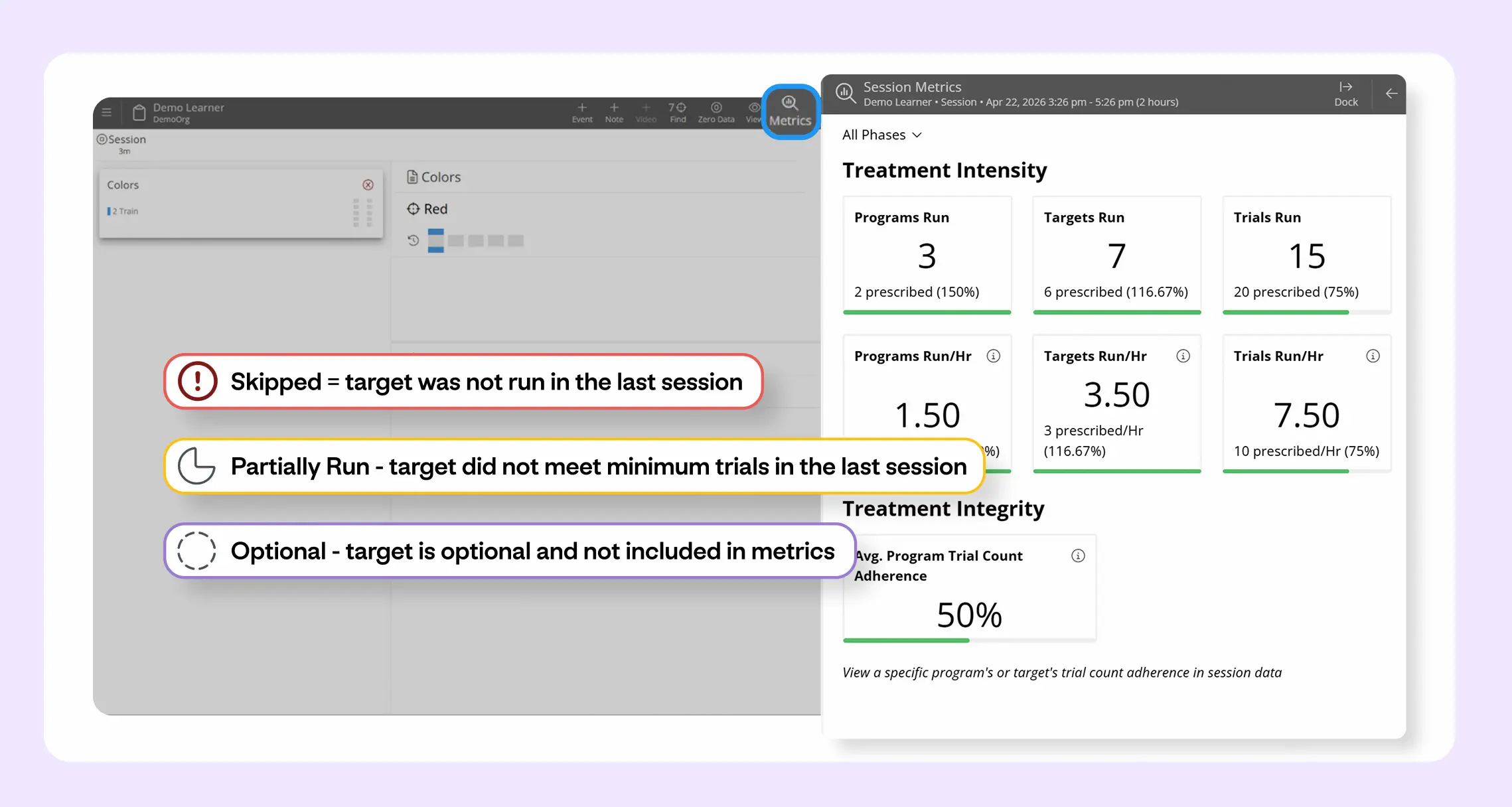
Jordan's checks (Was the schedule followed? Is it still working? Does staff need to adjust?) depend on data being there when they’re needed. That's what Motivity’s data collection gives clinicians: real-time session data and fidelity tracking that support these calls instead of leaving them to memory or a spreadsheet at the end of the month.