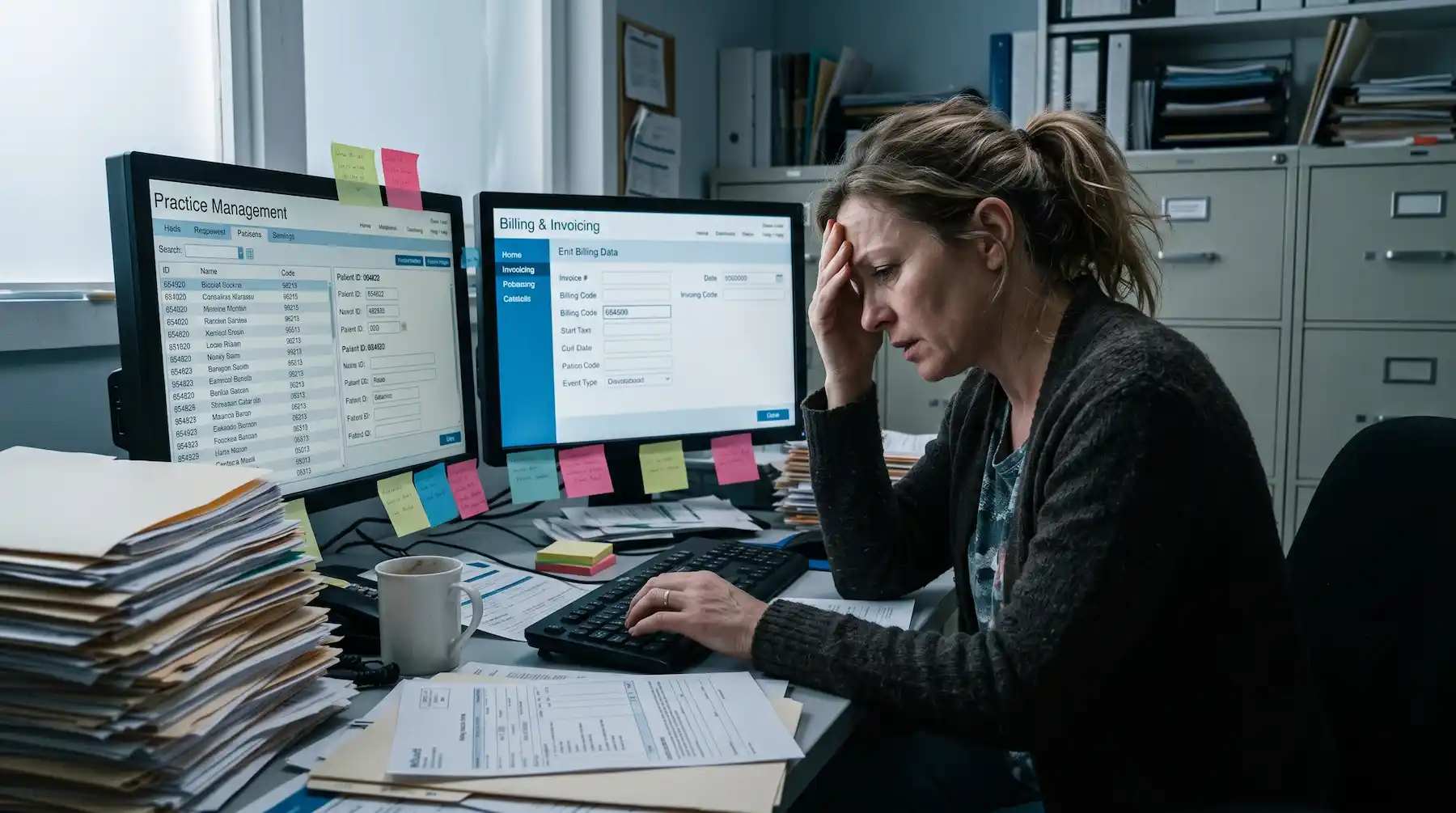
If you ran an ABA practice this year, you probably felt the ground shift a little in a steady drip of new billing rules, tighter audits, and schedules that suddenly behaved like living creatures. You might’ve updated a few templates, rewrote some workflows, and reminded your team (again) to double-check their session types. And still, things changed faster than anyone liked.
Even if nothing from 2025 came as a complete surprise, it felt like someone turned the brightness up on problems that were already there. Documentation gaps. Siloed scheduling. Missing supervision details. Parent training done over video but billed the old way. In short: a growing need for systems that don’t fall apart when the rules shift three months in a row.
These industry shifts made supervisors busier, scheduling harder, and billing more delicate.
2025 Put ABA Providers Under a Sharper Microscope
One of the biggest lessons for ABA in 2025 was that documentation needed to be tighter than ever. Not prettier or longer, just cleaner and aligned to what payors were requiring.
EVV and federal enforcement made accuracy part of the workflow
Electronic Visit Verification requirements continued to toughen in states like New Jersey, North Carolina, and Pennsylvania. Start times, stop times, locations, and provider verification became non-negotiable.
And federal enforcement of behavioral health parity pushed payors to examine how ABA hours were being authorized and delivered. That meant more internal checks than ever.
The takeaway was that as rules tightened, the teams with scattered workflows felt every change twice, while the practices that had strong systems kept moving.
Compliance Became an Everyday Job, Not a Cleanup Project
Compliance changed too, especially around onboarding and supervision.
RBT® onboarding got simpler on paper but tougher in practice
The RBT application shifted to a single-step process. Applicants no longer upload diplomas. Instead, BCBAs® attest that requirements were met. It sounds simple, but it created more responsibility for ABA practices that now have to track background checks, education verification, and training accuracy on their end instead of letting applicants handle it.
Fieldwork rules required more structure
The clarification that unrestricted hours must be tied to a specific client forced supervisors to tighten how they guided trainees. “General studying” stopped counting. “Work that benefits a specific client” became the expectation.
If you didn’t already have a way to track supervision by learner, it probably felt like a scramble.
Fragmented systems made everything more fragile
Many teams tried to keep up using a mix of Google Drive folders, spreadsheets, PDFs, and old software held together with good intentions.
A few examples ABA providers saw this year:
- A credential expired but wasn’t caught until after billing.
- A session was authorized for a certain role, but the wrong provider showed up.
- A payor required a specific template change, yet half the team still used the old one.
- Authorization details lived in one tool, scheduling in another, and billing somewhere else.
These issues, multiplied across staff and locations, increased audit risk.
📌 Further reading: Is Your ABA Practice Truly Audit-Ready? Why “Prep Week” Is Already Too Late
Technology Took a Leap, and the Gap Between Good and Poor Systems Grew
While teams were trying to keep up with new requirements, technology kept moving too.
Practices began adopting tools that helped match staff to learners based on availability, credentials, authorizations, and even travel time. It solved the problem of too many schedules relying on memory, and a stack of sticky notes someone kept at their desk.
The practices using smart scheduling systems that flagged under-utilization early or suggested back-to-back sessions that keep staff moving efficiently saw immediate wins. The ones using spreadsheets and manual processes had a harder time keeping up.
And technology mattered in another way this year, one that was not related to automation, but with flexibility. More ABA centers leaned into naturalistic, play-based sessions and pulled in parents, teachers, and specialists to build fuller programs. It’s a great direction for learners, but it demands more flexibility from the tools behind the scenes because it requires more session types, variation in targets, communication with parents, and real-time adjustments.
That approach only works when your system can bend with you. One practice summed up this need for adaptation, and the way Motivity addresses that need, beautifully:
“Motivity is flexible, which is the model of LGT’s brand of ABA. We are flexible and naturalistic, and that is a key component for quality care. Motivity allows us this flexibility, unlike other software on the market.”
—Stephanie Koh, Founder, Little Green Tugboat
That might be the clearest lesson from 2025: the right tools help, but only when they fit the way ABA teams actually work.
3 Things ABA Practices Can Do Now for a Steadier Future
1. Organize documentation so it stays consistent and lives in one place
If templates aren’t standardized or updated when payors update their rules, you’ll always be chasing problems downstream.
Audits get messy when documentation, billing, schedules, and provider information live in separate systems. When everything talks to each other, your team can move faster and your claims aren’t at risk because something got lost in a spreadsheet.
2. Watch schedules and hours the way you’d watch a budget
Unused hours, mismatched provider assignments, travel gaps, and last-minute cancellations made practices lose money without noticing.
The practices that stayed steadier this year were the ones that caught issues early. Having a system that balances workloads across your staff, leaves fewer gaps, and no surprises at the end of the month can save hours of cleanup later.
3. Let compliance reminders run in the background instead of your brain
Credential expirations, supervision requirements, and authorization limits shouldn’t rely on someone remembering. ABA systems that handle document reminders automatically make supervisors and billers stop wasting time looking for dates in old documents.
Bonus: Clean Up Your Workflows Before 2027
The ABA Coding Coalition confirmed that the AMA approved a major overhaul of ABA-related CPT codes for 2027, including a rewrite of the adaptive behavior group and six new additions. We won’t see the fine print until the CPT manual is released, but we already know what it means for practices.
2026 needs to be a cleanup year. Templates, session types, supervision notes, parent-training documentation—everything needs to be consistent and easy to update when January 2027 comes around.
If 2025 taught practices anything, it’s that you don’t wait for the overhaul to begin before fixing the leaks.
How Motivity Helps ABA Teams Build a More Predictable Practice
Motivity is designed for the things ABA practices deal with every single day: changing rules, complex schedules, evolving care models, and the pressure to stay compliant without drowning staff in admin work.
Teams that use Motivity tend to feel the difference early on:
- Schedules settle down because the system catches conflicts early.
- Supervisors spend less time hunting for information.
- Documentation stays consistent across locations.
- Authorizations and credentials stay visible instead of buried in a file.
- Billing feels less like a fire drill.
Motivity learns from its ABA community, and those insights shape how the platform improves over time. As Kimberly Hull, President of Achieve Ability Therapy, put it:
“The entire Motivity Team is SO responsive to their customer's needs. They really listen and customize the platform based upon that feedback. I cannot recommend them enough. Motivity offers an exceptional platform at a fair price. I feel like we are finally able to ditch the antiquated data binders and move into a new era.”
If you want steadier operations, cleaner billing, or schedules that don’t collapse when one thing changes, we’d be happy to show you how Motivity fits into your practice.